Todorka Ristovska – Managing Director at Liberty Skopje
Within the framework of the project “CBC Job Gender and Age Equalizer” we have launched a series of interviews to promote good practices, laying emphasis on the contribution of women employed in traditionally male industries. Through their experiences and success stories we strive to encourage and motivate the programme target groups. In this interview, we are speaking with Todorka Ristovska, Managing Director at Liberty Skopje.
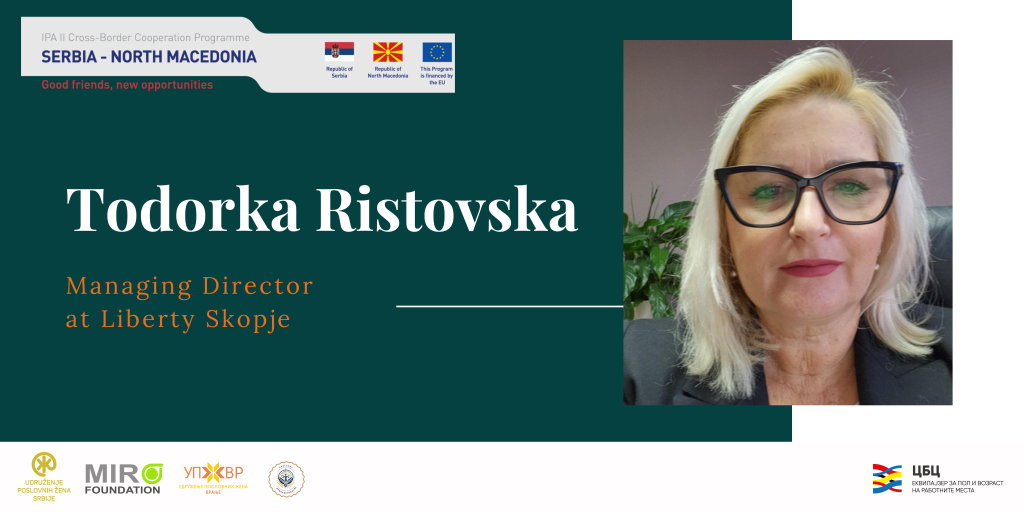
Todorka embarked on her career in the steel industry over 19 years ago, assuming managerial roles across various sectors. Initially she worked for ArcelorMittal, then transitioned to Liberty, where she currently holds the position of Managing Director. She previously gained experience in sales and technical support for bearings from renowned manufacturers such as SKF, KOYO and SNR.
Regarding the company, Liberty Skopje operates as part of the Liberty Steel Group, a global steel and mining company with 200 production facilities in 10 countries. The company ranks as one of the biggest manufacturers of steel products in the Balkans, offering a range of products such as cold-rolled coils and plates, galvanised coils and plates and plastic-coated coils. These products are primarily used in construction and the general industry, catering to markets across the Balkans and Southeast Europe.
Founded in 1967, the cold rolling mill is among the largest companies in North Macedonia, currently employing more than 420 individuals. Starting from hot-rolled coils as input material, the factory has facilities for processing through multiple stages: pickling, cold rolling, annealing, galvanizing, plasticizing and packaging.
The company’s operational philosophy centres on the production of safe and sustainable steel, while delivering a flexible, reliable service characterised by short lead times and exceptional relations with customers.
What does success signify to you in your career, and how has this concept evolved from the beginning to where you are now?
For me, success in my career is reflected in the fact that, after many years of experience in the steel industry and holding various positions without facing prejudice due to my gender, the top management of the GFG Group entrusted me with the role of Managing Director of the factory, in circumstances when the steel industry was confronted with some of its greatest challenges.
Of course, for such a decision to be made, it was imperative to demonstrate results across all areas of my work, as well as innovation, perseverance, leadership and loyalty to both my superiors and the company. I can say that working in the steel industry is complex and requires continuous self-improvement in every professional domain and substantial experience in what you do.
I began my career at one of the largest steel companies in the country, first with ArcelorMittal, and then with Liberty AD Skopje, both multinational corporations present across all continents worldwide. I was fortunate to have had exceptional mentors with extensive experience, and as I often say, corporate culture which was the reason for me to stay in the company and build my career. The cornerstone of my career has been the fact that I never measured my efforts by the salary I received, but rather by my commitment to exceed the expectations of my superiors. I embraced every challenge, worked on resolving issues and achieved results even in the face of seemingly impossible tasks.
So, after 20 years spent in various departments, from Purchasing Officer to Purchasing and Logistics Director, Supply Chain Director and Operations Director, I reached my current position, which I have held for the past two years.
Throughout all these years, the corporations have enabled me to progress further by attending national and international training sessions and academies, and to put all those years of experience into practice by leading the company, even amid the ongoing major steel crisis.
What have been the greatest challenges you have encountered as a woman in this field and how did you overcome them?
I am supposed to say that my greatest challenge was to prove myself as a woman in the male-dominated steel industry, but quite the opposite occurred, my colleagues accepted me from the very beginning despite me being a woman, because I was always present at the manufacturing plant whenever the nature of my responsibilities called for it, whereas the challenge of being a parent and a wife while simultaneously overseeing the operations in the factory, proved to be the real difficulty for me. Many times, I found myself facing difficult decisions, such as returning from vacation due to an urgent work situation or staying in a work-related meeting instead of attending a parent-teacher meeting, thus not being with my family precisely when they needed me the most. I may have missed out a lot as a parent, but eventually, that is the price we have to pay to make a career. This holds true for all women who choose to work in our industry. Fortunately, we have the understanding and support from our loved ones, so the choice between a career and a family often comes down to a compromise on both sides.
Do you have a moment or experience in your career that has been particularly inspiring or rewarding?
In fact, I always chose the more challenging path. I took on projects that I knew nothing about, that no one else was willing to undertake, that were outside my domain of expertise, but I was eager to try and prove myself. It was a new focus that I wanted to devote myself to, beyond my regular responsibilities. That was what truly set me apart from others, it was what I was recognised for, and eventually, valued for. My greatest achievement was the moment when GFG appointed me to lead the company, taking into account that there had been no local leader of the company up until that point. This allowed me to be one step ahead.
How do you think gender diversity affects the work environment and problem-solving in your workplace?
I do not mean to sound pretentious, but women have predominantly leadership roles within our company. Of the six members of our board of directors, four are women and all of them are highly successful, ambitious, innovative, loyal, meticulous, and of course, in the end the results speak for themselves. It has been proven that women rarely, if ever, relent in their pursuit of the desired outcome, even when it demands considerable time and energy. Gender diversity has had a positive influence on the work dynamics in our management team.
In what ways do you think your work as a woman in this field will influence future generations?
I sincerely hope that prejudices are now a thing of the past. We are increasingly seeing more female engineers in direct manufacturing, maintenance, projects, quality control, automation, crane operation, etc. Many of them are at the beginning of their careers and I hope they will have the opportunity to achieve the aspirations they pursue. My mission is to provide them with professional advancement and the same level of support I received, in order to empower them to remain resilient and successful.
What would you advise young women considering a career in this field?
Speaking from experience, I can say that a woman can certainly be successful in the steel industry or in any other industry, but a sufficient period of time has to pass so that she can demonstrate her ability to bear the burden of challenges, be persistent, be confident in her capabilities, work on herself, persevere even in the midst of difficulties, win over all those who may have doubts. Unfortunately, it takes significantly more time and effort for women than for men, but once they succeed, it brings immense satisfaction to themselves and their loved ones.
Did you have mentors or other forms of support that provided help throughout your professional journey? How do you perceive the significance of such support?
The significance of mentoring is paramount to achieving success. I had the privilege to learn from the best who were also my superiors. Working in a multinational corporation had a direct effect on the development of my character and professionalism, as I was mentored by leaders from diverse Western and Eastern cultures, each bringing unique experience and knowledge. They invested in me and enabled me to attend numerous academies and training events, both within the country and abroad, so that I could take on a new role exactly when they believed I was prepared enough.
Today, it is just as important for us as a company that talented and ambitious young employees are recognised by their superiors, regardless of their position, and that they are provided with appropriate training for professional development, in order for them to step up and represent the new generation that will lead the company.