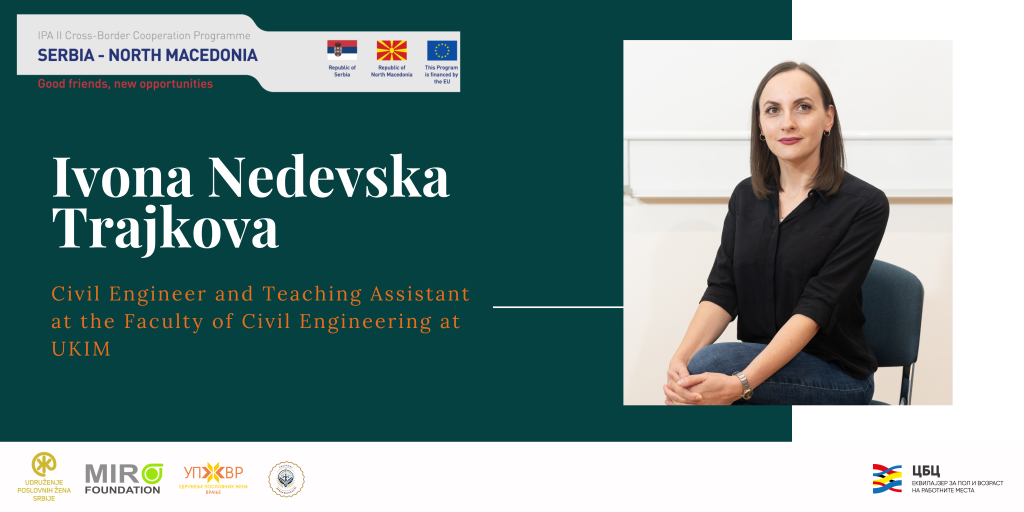
Ivona Nedevska Trajkova – Civil Engineer and Teaching Assistant at the Faculty of Civil Engineering at Ss. Cyril And Methodius University in Skopje
Within the framework of the project “CBC Job Gender and Age Equalizer” we have launched a series of interviews to promote good practices, laying emphasis on the contribution of women employed in traditionally male industries. Through their experiences and success stories we strive to encourage and motivate the programme target groups. In this interview, we are speaking with Ivona Nedevska Trajkova, Civil Engineer and Teaching Assistant at the Faculty of Civil Engineering at Ss. Cyril And Methodius University in Skopje.
Ivona, could you please give us a brief introduction about yourself and your professional background?
I am Ivona Nedevska Trajkova, a Civil Engineer and Teaching Assistant at the Faculty of Civil Engineering at Ss. Cyril And Methodius University in Skopje, specializing in the field of transport infrastructure, railway systems and urban mobility. I am currently a doctoral candidate at the same institute, focusing on the geometric degradation of railway tracks and their maintenance.
Since 2021, I have worked as a Teaching Assistant at the Faculty of Civil Engineering, where I conduct exercises, mentor student projects and participate in scientific research in the field of transport infrastructure. I am actively working on the preparation of teaching materials and cooperation with industry partners for practical training.
My scientific and research engagement includes publications in international journals indexed by SCOPUS and participation in conferences. I worked on significant projects as a consultant for the construction of corridors VIII and X-d, as well as the highway Kichevo-Ohrid. My efforts are focused on modernizing the transport infrastructure in Macedonia and supporting the future generations of engineers.
What does success signify to you in your career, and how has this concept evolved from the beginning to where you are now?
Success is a concept that has evolved for me over the years and throughout my experience. At the very beginning of my career, success meant earning my degree, securing my first job in construction, and an opportunity to apply the theoretical academic knowledge into the real world. It was a period of intense learning, self-proving and adapting to the challenges this profession presents.
Over time, my definition of success has evolved. I realised that success is not just about personal achievements, but also about the impact I have on my team, my students and the economy at large. I have started to measure success by the quality of my work, the projects I complete and the knowledge I pass on to future generations.
Today, as a Teaching Assistant, success for me means seeing that a student has gained confidence and practical skills through my mentorship. Success is when my hard work and research can contribute to the advancement of the construction industry, whether through new technologies, sustainable solutions or innovative approaches.
What have been the greatest challenges you have encountered as a woman in this field and how did you overcome them?
Construction has traditionally been considered a male-dominated profession, but my experience has been positive – I was welcomed by my colleagues, who consistently showed respect for my knowledge and work. I never felt overtly discriminated against or underestimated, on the contrary, I was often met with support and encouragement.
However, one interesting pattern that I observed, particularly during on-site visits, was that my colleagues tended to be more cautious and protective of me, although there was no real need for it. I frequently heard comments like, ‘Be careful, it’s slippery here’ or ‘Are you going there, can I check for you?’ While this was well-intentioned, it highlighted how certain tasks, which seemed natural for men, were approached with more caution when it came to me.
Over time, I have demonstrated that I was equally prepared for on-site work and that there was no need for additional concern simply because I was a woman. My colleagues gradually adapted and began to treat me as an equal member of the team. Ultimately, what mattered most was mutual respect and the quality of our work.
Do you have a moment or experience in your career that has been particularly inspiring or rewarding?
Throughout my career as a civil engineer and a teaching assistant, I have experienced many inspiring and rewarding moments, but a few stand out as particularly significant.
I take pride in every project I have worked on and successfully completed, especially considering that many of them are transportation infrastructure projects of critical importance to the whole country. These projects go beyond engineering tasks – they represent vital improvements to the entire transportation system, directly impacting individuals by enhancing safety, efficiency and economic development. Every time I see a project I have contributed to put into operation and delivering real benefits to citizens, it fills me with immense professional pride.
In addition, I am proud of my role as a teaching assistant and future professor, because teaching and mentoring students provide me with the opportunity to shape future generations of engineers. It is the students who confirm that my work holds real meaning.
The opportunity to engage in research that can introduce innovations into the transport infrastructure, offer sustainable and efficient solutions and contribute to the advancement of the profession, motivates me to continue with my scientific endeavours.
Perhaps one of the most significant moments in my career is yet to come – the defence of my doctoral thesis, to which I have dedicated several years. This process is one of my greatest challenges, but also one of my greatest sources of inspiration. Doctoral studies demand perseverance, thorough research and commitment, but the final result will serve as the crowning glory of my work and a significant contribution to both science and the economy.
Each successful project, each grateful student and each scientific paper that advances the field of engineering reminds me why I chose this profession and fuels renewed motivation to continue with the same dedication and enthusiasm.
How do you think gender diversity affects the work environment and problem-solving in your workplace?
Gender diversity is a significant factor in any professional environment, particularly in construction and academia, which have traditionally been male-dominated. From my experience, teams that embrace people with diverse perspectives – whether in terms of gender, experience or professional background – tend to be more effective, creative and adept at tackling complex challenges.
In construction, every project demands a multidisciplinary approach, critical thinking and collaboration among professionals with varying expertise. Under such circumstances, gender diversity plays a major role because it introduces different perspectives in analysis, decision-making and problem-solving. Female engineers often bring strong analytical skills, attention to detail and innovative solutions – assets that are particularly valuable in design, team organisation and risk management.
Such diversity is also evident in communication and teamwork. Women in engineering often adopt a more inclusive approach, encouraging collaborative brainstorming and reducing hierarchical barriers. This is especially important in fast-paced environments like construction, where team decision-making leads to more effective solutions.
In academia, this kind of dynamics is even more pronounced. I have observed that female professors often foster an open, supportive environment that encourages students, particularly those with lower self-esteem, to become more proactive. This is especially vital for young women interested in engineering, as positive role models and support are crucial in guiding their decision to pursue a career in the field.
Gender diversity also plays a role in problem-solving. Mixed teams tend to conduct deeper analyses and generate more creative solutions, as different perspectives help anticipate potential issues before they arise. For example, when working on engineering projects, female engineers often adopt a more detailed approach to analysis, which can help prevent errors in planning and designing.
While working on a project to design a new road section through hilly, mountainous terrain, our team faced the challenge of routing the road through unstable ground, which would have caused high stabilisation costs and prolonged construction. Some members of the team suggested a traditional solution involving retaining structures for ground stabilisation, but a few colleagues and I proposed an alternative approach – shifting the route towards more stable terrain with the aim of avoiding the need for extensive retaining structures and costly geotechnical interventions. This approach enabled a reduction in stabilisation costs, shortened construction time and improved the long-term stability of the road. This example illustrates how detailed analysis, diverse approaches within the team and innovative thinking can lead to more efficient and sustainable engineering solutions.
I believe that the future of construction will be even more diverse and that gender equality will continue to play a growing role in fostering better, more efficient engineering teams.
In what ways do you think your work as a woman in this field will influence future generations?
My work as both an engineer and an academic staff member is not just a personal achievement – it is part of a broader shift in the construction industry and academia. I believe that with every step I take, I can leave a positive impact on future generations, especially on young women considering a career in this field.
Construction has long been seen as a male-dominated profession, but today, more and more female engineers demonstrate that the industry has room for anyone with knowledge, ambition and dedication. Through my work, I aim to prove that gender barriers can be surpassed, and that what truly matters in engineering is expertise, integrity and innovation, not gender.
As a teaching assistant, I am in a position to have a direct influence on students – not only by imparting knowledge, but also by motivating them to follow their passion and join this profession without fear or uncertainty. I have always been aware that my example can serve as inspiration, particularly for female students who may question whether construction is “right” for them. I have had the privilege of working with female students who were initially uncertain, but over time, with support and hard work, they gained confidence and went on to build successful careers in engineering.
Looking ahead, I am focused on the impact I can have on future generations and I am committed to helping change the perception of what it means to be a successful engineer. Construction has been associated with physically demanding work for too long, but with the development of technology, digitalisation and new engineering methods, it is becoming clearer that this profession requires analytical thinking, creativity and decision-making capacity – skills that are universal and independent of gender.
I believe the future of construction will be even more diverse, inclusive and dynamic, and I am determined to play a part in that positive transformation.
What would you advise young women considering a career in this field?
The most important piece of advice I could give to young women aspiring to pursue a career in construction and academia is to believe in themselves and their abilities. This profession offers tremendous opportunities for growth, innovation and creation of lasting projects, but it also demands dedication, analytical thinking and perseverance. Never allow prejudice or self-doubt to hold you back – if you are willing to put in the effort and continually improve, there are no limits to what you can achieve.
Focus on continuous learning and self-development. Construction is a dynamic field that is always evolving. Staying up to date with new technologies, participating in research, seminars and projects, and honing your skills is very important.
Build a strong professional network. Seek out mentors and professional contacts because they will help you develop and navigate your career. Building up professional contacts is not just crucial for finding opportunities, but also for sharing knowledge and experiences with others.
Do not shy away from challenges. Sometimes, there will be moments of uncertainty or scepticism, but it is essential to remain persistent. Challenges are valuable opportunities to learn and grow.
Be prepared for on-site work. Construction is not just about office work – practical field experience is invaluable. Do not let anyone tell you the field “is not for you.”
Be an inspiration to others. As you gain experience over time, help the future generations of engineers – regardless of gender – discover their professional path.
Ultimately, the most important thing is to believe in yourself, work hard and never let anyone’s prejudices define you.
Did you have mentors or other forms of support that provided help throughout your professional journey? How do you perceive the significance of such support?
Yes, mentorship and support have played a pivotal role in my professional development. I believe that no one achieves success on their own – the right mentors, advisors and supporters can make a difference between an average career and an exceptional one.
In the early stages of my career, particularly during my first experiences on site and in designing, mentors were essential in helping me acquire practical skills. The experienced engineers I worked with taught me how to think critically, make decisions in complex situations, and bridge the gap between theoretical knowledge and real-world application. One of the most valuable pieces of advice I received was: “Do not be afraid to ask – it is better to learn early than to make a costly mistake.” This made me realize that asking questions is not a sign of weakness, but rather a reflection of ambition and desire to learn.
In the academic world, support from more experienced professors was equally crucial. My mentors assisted me in developing my research skills, learning how to write scientific papers, and showed me how to teach in a way that would be inspiring to students. What motivated me the most was their trust in me – that they offered me opportunities to participate in research and conferences, helping me grow as a future professor.
In addition to formal mentors, my colleagues also played a pivotal role – the people with whom I shared experiences, challenges and ideas. Sharing knowledge and mutual support allowed us to progress together.
Now that I am in the role of a mentor myself, I strive to pay forward the support I received. By working with students and young engineers, I try to help them build confidence, provide them with practical advice and encourage their continued growth in research and professional development. I would like to create an environment where young people, regardless of gender, feel supported in pursuing their career in civil engineering. I believe that great engineers are not shaped in isolation – they grow through experiences, learning and collaboration with others.
Therefore, whenever the opportunity arises, seek out mentors, ask questions and learn from those with more experience. And when your time comes, give that support back – because the future generations of engineers will need the same guidance we once received.