Ema Pandilova – Machine Learning Engineer and Teaching Assistant at the Faculty of Computer Science and Engineering in Skopje
Within the framework of the project “CBC Job Gender and Age Equalizer” we have launched a series of interviews to promote good practices, laying emphasis on the contribution of women employed in traditionally male industries. Through their experiences and success stories we strive to encourage and motivate the programme target groups. In this interview, we are speaking with Ema Pandilova, a Machine Learning Engineer.
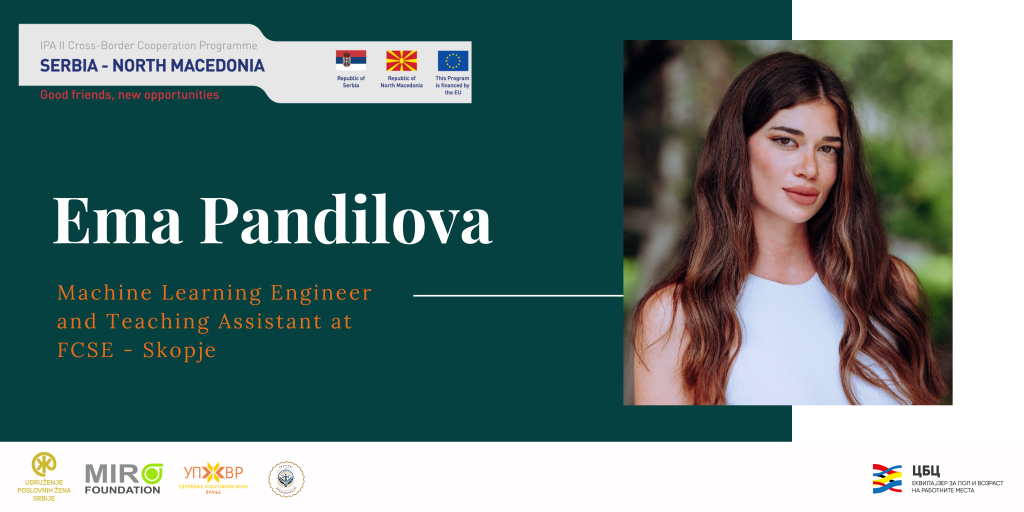
Ema Pandilova, born in 2001 in Skopje, has built a solid academic and professional career in software engineering and information systems. She completed her high school education with continuous excellence at SUGSG “Orce Nikolov” in Skopje. During this time, she participated in multiple mathematics and biology competitions, earning numerous awards and recognitions. In 2020, she enrolled in undergraduate studies in software engineering and information systems at the Faculty of Computer Science and Engineering in Skopje. Due to her high achievements and continuous success, she was repeatedly awarded scholarships.
In 2022, during her third year of undergraduate studies, she began working as a laboratory assistant at the same faculty. Alongside her studies, she worked in the industry as a machine learning engineer and contributed to several software projects. She graduated in 2024 with an average grade of 9.64, completing a thesis on “Knowledge Transfer with YOLO for Object Detection in Satellite Images.” With this thesis, she also participated in the ICT Innovations conference held that same year in Ohrid. Immediately after graduating, she enrolled in a master’s program in Software Engineering at the Faculty of Computer Science and Engineering. That same year, she was also engaged as a teaching assistant at the faculty.
Her main areas of interest include machine learning, computer vision, deep learning, software engineering, and generative artificial intelligence.
She currently works as a Machine Learning Engineer at Loka, where she contributes to the development of innovative projects with broad applications, ranging from healthcare to education and science, making a significant impact on their improvement through advanced artificial intelligence. Ema is also a teaching assistant at the Faculty of Computer Science and Engineering, where she shares her knowledge and experience with future engineers, fostering, among other things, greater participation of women in STEM fields.
What does success signify to you in your career, and how has this concept evolved from the beginning to where you are now?
Success is a very subjective concept. For one person, success may mean a morning yoga session or working outdoors in a sunny park, while for another, it could mean much more. This concept and my understanding of it have changed a lot over the years.
At the beginning, I thought that success was synonymous with earning my degree at the end of my studies, but I quickly realized that the story doesn’t end there. From the start of my academic journey, success for me meant being the best at what I do, winning awards, and earning recognition.
Over time, as my professional experience grew, my definition of success expanded to include the development of solutions that not only address technical challenges but also improve the quality of life for users. Today, success for me also means sharing my knowledge with future generations of engineers, especially encouraging young women to enter and advance in STEM fields.
Ultimately, success is not a final destination, and failure is not a catastrophic end. What truly matters is the courage to keep moving forward. The deeper meaning of success may lie in the ability to balance professional aspirations with personal life, ambition with inner peace, and the innovations we create with the life we live.
What have been the greatest challenges you have encountered as a woman in this field and how did you overcome them?
Honestly, in my experience as a woman in this field, I haven’t faced significant challenges that were solely due to my gender. From my student days to my professional career, I have been fortunate to be part of environments where the primary focus was on knowledge, dedication, and results rather than gender. I have always felt valued based on my expertise—my ideas and initiatives were taken seriously, and the opportunities I received depended on my achievements.
Of course, this doesn’t mean there weren’t any challenges, but they were the usual professional challenges, such as mastering new technologies or taking responsibility for difficult projects. I overcame them through hard work and the support of my colleagues—not by fighting barriers based on gender.
Knowing what many women face, I wholeheartedly support projects and initiatives that help women in STEM overcome traditional barriers. I believe that with mutual support and solidarity, we can create an environment where all talents have the opportunity to shine. At the end of the day, success in science and engineering should depend on knowledge and effort, not gender.
Do you have a moment or experience in your career that has been particularly inspiring or rewarding?
Throughout my career so far, there have been several moments that confirmed that effort, dedication, and passion for what you do always find a way to be recognized. From my student days, I realized that every effort, even for the smallest tasks, pays off—not just through grades but through an internal sense of fulfillment.
This dedication brought me multiple recognitions from my faculty, including an award for being one of the top students of my generation with an average grade above 9.5, as well as continuous scholarships from both the faculty and the Ministry of Education and Science. These were signals that I was on the right path.
However, perhaps the most inspiring moments today come from my interactions with the students I teach. Their feedback, honest comments, and the surveys they fill out after classes are a strong motivation for me. They prove that when you invest energy, love and sincere intention, it doesn’t go unnoticed. These small affirmations in everyday life inspire me to continue with even more enthusiasm—not just to pass on knowledge but also to encourage and support future generations.
How do you think gender diversity affects the work environment and problem-solving in your workplace?
From my experience in both academia and industry, gender diversity has a profound impact on workplace culture and the way problems are solved. When a team includes people from different backgrounds, perspectives, and experiences—including gender diversity—it fosters a richer and more open collaborative environment.
In academia, this is evident in how students are approached and how the teaching process is structured. Women and men in our teams contribute with different communication styles, different paces, and varying sensitivities to certain topics, which results in a higher-quality learning experience for students. This diversity helps achieve balance, which is crucial for a healthy academic process.
In industry, gender balanced teams, in my experience, generate more diverse ideas and more flexible problem-solving approaches. Women in teams often initiate discussions about improving processes, bring greater sensitivity to interpersonal relationships, and encourage communication that goes beyond strictly technical aspects. This creates a dynamic where innovation stems not only from technical knowledge but also from a culture of collaboration.
I believe that true diversity—not just as a statistic but as a fundamental value—builds an environment where everyone has the space to contribute and grow, allowing teams to develop better and generate more creative solutions.
In what ways do you think your work as a woman in this field will influence future generations?
Although I am still at the beginning of my professional career, I believe that every step I take has the potential to leave a mark—not only in my work but also in the way young women perceive their place in this field. The mere presence of women in technical teams, in teaching roles, or in leadership positions sends an important message: that there is no such thing as a “typical” engineer and that technology is a space open to anyone with the desire, curiosity, and dedication to pursue it.
As a demonstrator and mentor to younger students, I often receive questions and comments that show how my presence, engagement, and communication style have an impact. This gives me additional motivation—to continue working with dedication and transparency, knowing that I might inspire a young girl to believe that she, too, belongs here.
I believe that the long-term impact is not only measured by the technologies and projects we develop but also by the encouragement we offer to others. If my work contributes even a little to creating a more inclusive, diverse, and welcoming technological community, then that is one of the most valuable rewards of this journey for me.
What would you advise young women considering a career in this field?
To all young women thinking about a career in STEM, I would say: do not let fear or doubt dictate your future. If you feel passion for science, technology, or innovation—follow that calling, give it your best, and believe in your abilities, even when the path seems difficult or unclear.
The increased participation of women in these fields is important not just for equality but also because diversity brings new ideas, fresh perspectives, and better solutions. As the saying goes—diversity makes science more successful.
But the most important thing, something we often underestimate, is self-discipline. It is not always talent or luck that leads to success—it is perseverance, the ability to keep going even when things get tough, and showing up every day with the same dedication. That is the power that makes people unstoppable.
Believe in yourself, be confident in what you love, dedicate yourself with passion and persistence—and the results will come. And your success will not only be your personal victory but also a true inspiration for future generations.
Did you have mentors or other forms of support that provided help throughout your professional journey? How do you perceive the significance of such support?
Yes, I have been fortunate throughout my academic and professional journey to be surrounded by people who believed in me and supported me when I needed it most. Whether it was professors who encouraged me to apply for a challenge, colleagues who offered help without hesitation, or friends and family who gave me energy in moments of exhaustion—it all helped me stay focused and motivated.
I’m grateful to my mentors, university professors, who showed me what integrity in the profession looks like, how decisions in complex situations are made, and what a true professional should look like.
I believe that this kind of support—both mentoring and emotional—is crucial, especially in fields like technology, where you can sometimes feel lost or overwhelmed. Mentors do not always have to give you the exact answer—sometimes, it is enough just to ask you the right question or reassure you that you are on the right path.
That is why now, when I am in a position to help younger people, I try to be accessible, open, and honest—because I know how much even a small moment of support can mean at the right time.