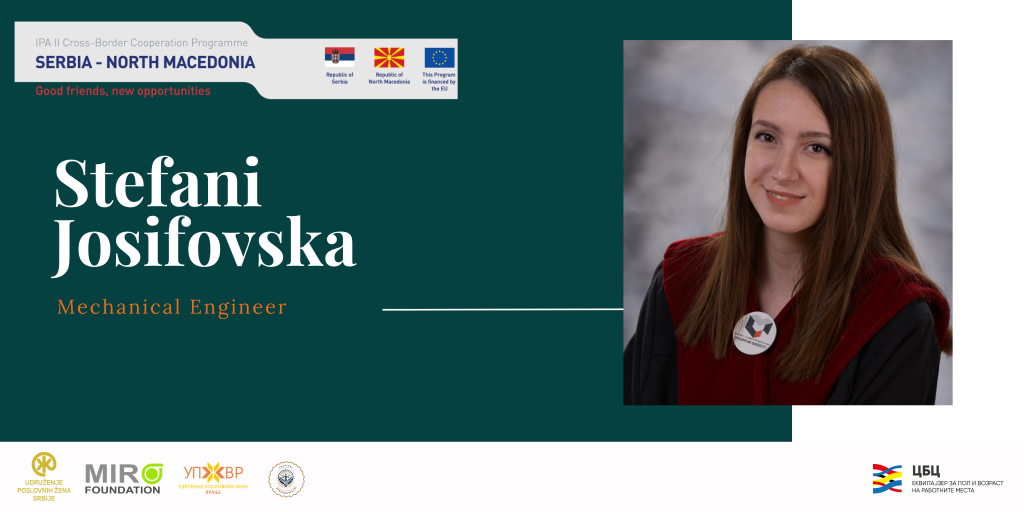
Stefani Josifovska – Mechanical Engineer
Within the framework of the project “CBC Job Gender and Age Equalizer” we have launched a series of interviews to promote good practices, laying emphasis on the contribution of women employed in traditionally male industries. Through their experiences and success stories we strive to encourage and motivate the programme target groups. In this interview, we are speaking with Stefani Josifovska, a Mechanical Engineer and part of the Audit Department at PwC Slovenia.
Stefani, could you please give us a brief introduction about yourself and your professional background?
I graduated from the Faculty of Mechanical Engineering in Skopje in 2022, specializing in motor vehicles. Immediately after, I began my master’s studies in the field of automated vehicle systems.
During my studies, I was actively involved in several extracurricular activities. Among them, I would highlight my work on various projects and scientific papers, as well as my engagement in student organizations to gain additional experience that traditional university programs do not always provide. During my student years, I took on roles such as event coordinator, financial officer, and treasurer, as well as being responsible for international students who came to Macedonia for internships through our organization. Additionally, I gained practical experience by completing three internships—one in Macedonia and two abroad in Spain and Slovenia.
In the first year of my master’s studies, I also worked as a teaching assistant at the Institute of Mechanical Constructions, Machinery, and Vehicles, while simultaneously expanding my IT knowledge. This led me to work as a frontend developer on a financial technology project in Slovenia. In that role, I began exploring UX design, eventually taking on independent responsibilities within the project. At the same time, I worked as a manager for the global student exchange program within IAESTE (an international organization for STEM students to gain practical experience).
Today, I am focused on finance, working in the Audit Department at PwC Slovenia. This position allows me to enhance the knowledge I have acquired so far, and I hope that in the future, I will have the opportunity to merge it with my engineering background.
What does success signify to you in your career, and how has this concept evolved from the beginning to where you are now?
At the beginning of my career, I believed that success was measured solely by achievements and major career milestones. However, over time, my perspective shifted. Today, I believe that the greatest career success is, above all, finding oneself in a field of interest and doing what we love. If we achieve that, continuous contributions to our projects, as well as meeting traditional “success metrics,” will follow naturally.
I also see constant learning, gaining new experiences, and later mentoring and motivating younger generations as key elements of success. These are aspects I strive for in my career.
What have been the greatest challenges you have encountered as a woman in this field and how did you overcome them?
Given that I specialized in motor vehicles, a traditionally male-dominated sector, there were certainly challenges. The biggest one was the stigma that only men are interested in automotive engineering and that women could never reach their level of expertise. However, I must admit that I was pleasantly surprised by how many of my colleagues were open to collaboration and held no biases against me or other female students.
During my student years, I was part of gender-balanced teams working on various projects, where both men and women had equally responsible roles. Later, after graduating, I found myself in projects where I was the only woman in the development teams. However, I did not feel any gender-based prejudice. I believe that, in recent years, due to the increasing number of women in these fields (mechanical engineering and IT, in my case), collective awareness has shifted significantly, and women’s equal participation in these areas is now more widely accepted.
Do you have a moment or experience in your career that has been particularly inspiring or rewarding?
I would definitely highlight the “Engineering Ring” award for 2022, as well as the gold medal awarded by the University of Ss. Cyril and Methodius for being one of the top graduates. These recognitions represented acknowledgment of my hard work and effort throughout my studies and motivated me to continue in the field of vehicle engineering at the master’s level.
Additionally, I was encouraged by the fact that, compared to previous years, the majority of award recipients were women. This is further proof that we are gradually achieving gender equality in these fields and being recognized for our contributions.
How do you think gender diversity affects the work environment and problem-solving in your workplace?
I believe that gender diversity is crucial in any industry, not just in engineering. I cannot say that men or women contribute more or are more important in a team—we inherently approach problems differently and think in different ways.
From my experience in both IT and mechanical engineering, I have noticed that when solving engineering or business problems, men tend to propose bolder ideas, while women think more pragmatically. This often results in a perfect balance between creativity and practicality, leading to the best possible solutions.
In what ways do you think your work as a woman in this field will influence future generations?
People always feel the need to belong to a group, so young women who are considering a career in STEM fields look for role models in women who have already built successful careers in those areas. In that sense, I believe that any woman in a traditionally male-dominated field serves as a source of motivation.
Regardless of how far along we are in our careers, simply choosing to enter these fields can inspire young girls to do the same by showing them that it is possible. If my career path motivates even one woman to pursue STEM, then I have already made a positive impact on future generations.
What would you advise young women considering a career in this field?
I would advise them to be brave and enter the professional world as early as possible. Gaining practical experience through projects or internships will help them understand what working in their chosen field is really like. This way, they will be able to decide early on whether it is the right path for them.
Additionally, I want to reassure them that even if they make the wrong career choice, there are plenty of opportunities in the world, and it is never too late to switch paths. Engineering is such a broad field that, with enough courage and proactivity, anyone can find a specialization where they can thrive and make a significant impact.
Did you have mentors or other forms of support that provided help throughout your professional journey? How do you perceive the significance of such support?
I believe that mentorship is one of the most important aspects of career development. The first mentors we encounter at the beginning of our careers are usually our university professors.
I was fortunate to work with a female professor specializing in motor vehicles, who served as a great inspiration for me, as she herself had successfully established a career in this field. I also had a mentor during my master’s studies, and I believe that at this stage, having a specialized mentor is crucial, as they are already deeply knowledgeable in the field and can provide valuable guidance.