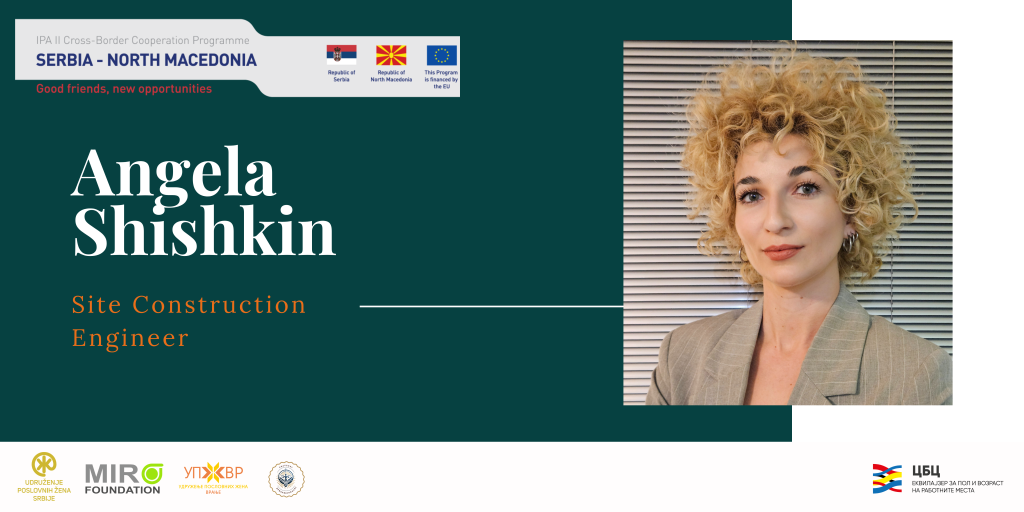
Angela Shishkin – Site Construction Engineer
Within the framework of the project “CBC Job Gender and Age Equalizer” we have launched a series of interviews to promote good practices, laying emphasis on the contribution of women employed in traditionally male industries. Through their experiences and success stories we strive to encourage and motivate the programme target groups. In this interview, we are speaking with Angela Shishkin, Site Construction Engineer.
Angela, could you please give us a brief introduction about yourself and your professional background?
I am MSc Angela Shishkin, a Site Construction Engineer. I currently work as an Assistant Project Manager on the ‘Construction of a Dam with Accompanying Structures Otinja, Stip’ at the company Stenton Gradba DOO, Bitola.
I completed my primary and secondary education in Bitola, where I specialised in a program for computer technology and automation. Initially, my focus was on IT engineering, but over time, I realised that I desired a career that involved hands-on fieldwork and communication with people. As a result, I enrolled at the Faculty of Civil Engineering, where I completed both my undergraduate and postgraduate studies in hydraulic engineering, earning a master’s degree.
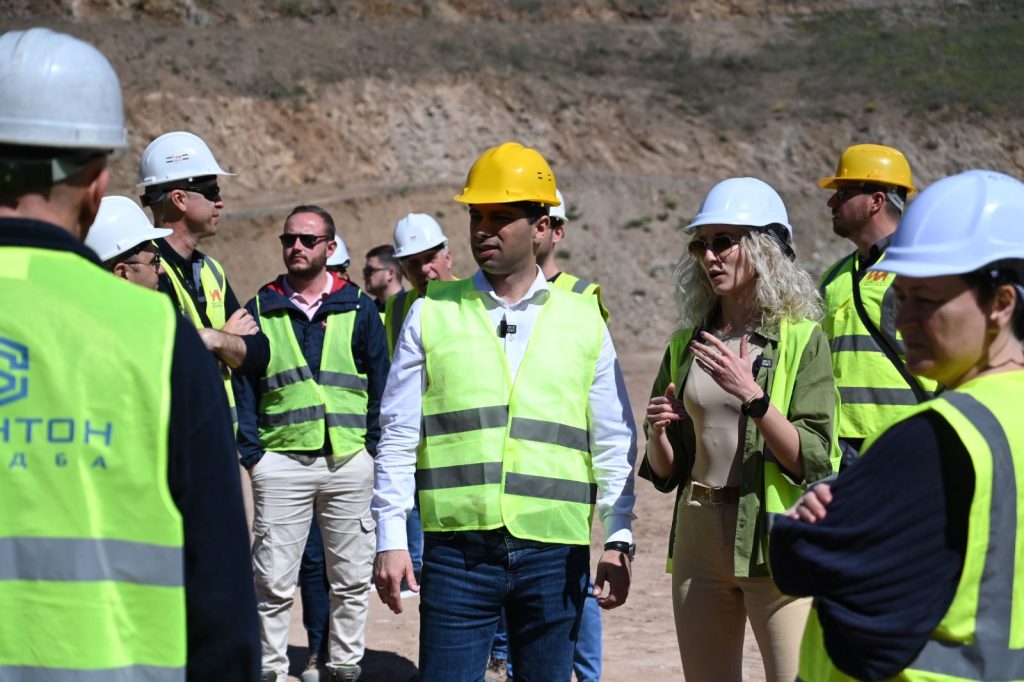
I have been working as a Site Construction Engineer for four years, leading high-impact projects that are of great importance for the country. Currently, I am part of the team overseeing the construction of the Otinja Embankment Dam, which stands 32.5 meters high. This project involves over 70 employees, and I am the only woman working on site. The work is dynamic and requires a high level of coordination – managing resources, teams and deadlines from the initial phase to final execution. What fulfils me the most is witnessing how our ideas and plans are transformed into real structures that have a lasting, positive impact on both the infrastructure and the environment.
I consider myself an honest, self-critical person who is always ready to embrace new challenges. I believe in the power of teamwork, and that every project is an opportunity to demonstrate professionalism through tangible results.
My goal for the future is to participate in the construction of structures that will improve the infrastructure and contribute to making the life of every individual easier. I want to continue working on projects that will have a long-term positive impact on the community and leave a lasting mark on the development of the country.
What does success signify to you in your career, and how has this concept evolved from the beginning to where you are now?
For as long as I can remember, my passion for and interest in engineering have been constantly present in my life. After completing my secondary education, I realised that I wanted my profession to be driven by on-site work, direct contact with the subject matter and people, and solving practical, everyday problems. Such ideas and energy fuelled my decision to enrol at the Faculty of Civil Engineering in Skopje, specializing in Hydraulic engineering.
The positive experiences during my undergraduate studies motivated me to continue my professional development, so I obtained a Master’s degree in the same field (hydraulic engineering). My professional path led me to the position of Site Construction Engineer, where I have been leading projects of great importance for the country for almost four years. I am working on complex infrastructure projects, including the Otinja Dam in Stip. Within the framework of this project, I work with a large number of employees, and the interesting part is that I am the only woman on the team.
Today, the success in my career is defined by the realisation and implementation of projects that hold significant value for our people and our country, projects that aim to build a better future for all of us as citizens. Leading such projects successfully involves forming a team that collaborates seamlessly, inspiring each individual to give their best so that they can achieve exceptional results. This requires adept management of time, budget and human resources.
What have been the greatest challenges you have encountered as a woman in this field and how did you overcome them?
Although the global trend is to eliminate gender segregation in professions, we still see that in our country, this change is happening more slowly and with greater difficulty. Given the nature of my profession, my first contact with the workers at the site also marked the appearance of the first (and until that point, the greatest) challenge in my workplace. However, after years of working experience and successfully fulfilling my responsibilities every day, scepticism and stereotypes have almost disappeared. Therefore, love for the profession, perseverance, hard work, daily learning and self-improvement, knowledge in areas related to your field, team-building activities, and respect for both fellow engineers and workers, lay the foundation upon which a career as a ‘woman in construction’ should be built. I believe that the greatest success is achieved only through teamwork.
Do you have a moment or experience in your career that has been particularly inspiring or rewarding?
On-site work is dynamic, often filled with unexpected challenges and great responsibility. My profession as an engineer brings me daily satisfaction because I witness first-hand how our ideas and plans are transformed into tangible, functional structures that enhance infrastructure and benefit the environment. One personal achievement from last year that I am especially proud of is presenting my paper titled ” Technical Solution for Adjusting the Basic Design in the Section of the Foundation Construction for Injection into the Base – Otinja Dam.” The paper was publicly presented at the conference on Dam Engineering in Conditions of Energy Transition and Aged Hydrotechnical Infrastructure, held at the KOAOI premises on November 19, 2024. Also, I eagerly look forward to the day when Otinja Dam will be fully operational.
How do you think gender diversity affects the work environment and problem-solving in your workplace?
I believe that for a team to be successful, it is vital that it is comprised of both men and women. Women engineers contribute significantly to detailed preparations and planning, and they particularly excel in creativity and innovation, on par with men. Men, on the other hand, tend to perform particularly well under pressure, in visual orientation, spatial planning and on-site activities. The key to a successful construction project lies in building a team that brings together diverse specialties and skill sets. By combining different abilities, perspectives and work styles, the team becomes dynamic, always ensuring the best possible outcomes.
In what ways do you think your work as a woman in this field will influence future generations?
I sincerely hope that my success story will inspire more women to embrace the challenge of being a so-called ‘woman engineer’ and help eradicate the stereotypes surrounding women in engineering professions. It is crucial for women to believe in themselves and trust the process they go through each day, while maintaining a clear vision of the goals they strive to achieve. I strongly believe that through my work method and approach, I can motivate my employers and others to employ more women in the industry.
What would you advise young women considering a career in this field?
A message to all young women considering a career in this field:
– Do not hesitate for a moment, but take that bold, massive step towards your dreams!
– Everything you truly desire is possible and achievable, as long as you keep your focus in the right direction. This profession is incredibly interesting and dynamic, offering new challenges and bringing something new and exciting every day. Construction is a field that provides endless possibilities for both personal growth and professional self-improvement, making it the perfect choice for any woman seeking a dynamic and fulfilling life.
Did you have mentors or other forms of support that provided help throughout your professional journey? How do you perceive the significance of such support?
Of course, I have had tremendous support, first and foremost from my family, and I would like to highlight my parents as the most important mentors since my earliest years. They instilled in me technical thinking, an engineering mindset for problem-solving, and taught me how to face challenges on my own. To this day, they provide me with unwavering emotional support, boosting my confidence and offering advice on how to navigate certain challenges in life. The support from my family is profoundly significant to me.
I would also like to acknowledge my first professional mentor. His experience and dedication to working with me were priceless. Thanks to him, I learned how to set clear goals and stay focused on them until they are fully realised. I am deeply grateful for the support these individuals have provided, as their guidance allows me to overcome the obstacles and professional challenges I encounter on a daily basis.
Being a mentor means selflessly sharing every ounce of knowledge, with the hope that it will be the sprout to grow and develop with boundless potential in the one who embraces and nurtures it.