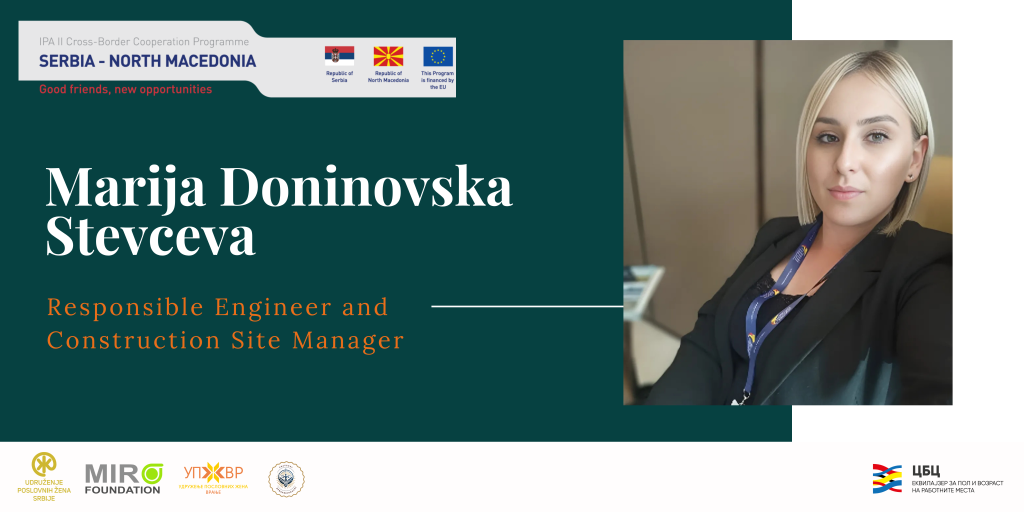
Marija Doninovska Stevceva – Responsible Engineer and Construction Site Manager
Within the framework of the project “CBC Job Gender and Age Equalizer” we have launched a series of interviews to promote good practices, laying emphasis on the contribution of women employed in traditionally male industries. Through their experiences and success stories we strive to encourage and motivate the programme target groups. In this interview, we are speaking with Marija Doninovska Stevceva, Responsible Engineer and Construction Site Manager.
Marija, could you please give us a brief introduction about yourself and your professional background?
I am Marija, a Master of Civil Engineering and a certified engineer with extensive experience in design, auditing, construction and supervision. Currently, I work as a Responsible Engineer and Construction Site Manager at a company specializing in the construction of roads, streets, bridges, supporting structures, and pipeline systems. Operating since 1998, our company employs over 60 professionals and features its own quarry, asphalt and concrete base, as well as a testing laboratory. We manage projects funded by the World Bank, local and state institutions, including private investors. We adhere to global standards, focusing on quality, safety and environmental protection.
My job position here includes performing all field and administrative tasks related to the facilities, daily meetings and communication with all parties involved in the project: supervisions, investors and subcontractors, public enterprises, state authorities, technical personnel, construction site organisation, quantity calculations along with preparation of financial documents for conducted work, inspection of materials, quality control, testing, planning and monitoring the progress of activities. As a team leader, I hold regular meetings with the team and thoroughly discuss the team’s achievements, issues and needs (according to the Scrum methodology), understanding the affinities of each team member and appropriately redelegating responsibilities. Individually, I engage as a supervising engineer and a design engineer.
What does success signify to you in your career, and how has this concept evolved from the beginning to where you are now?
Success in my career as a civil engineer has always been defined by hard work, desire and pursuit of professional training that would be sufficiently extensive to enable me to tackle not only standard tasks, but also more complex problems in construction. Intuitively, success has always implied a sense of personal competition, a desire to transform myself into a better version of myself with each passing day. Success is directly correlated with continuous effort, self-improvement and dedication, proactivity, implementation of vision. Initially, the concept of success for me personally meant unrestricted learning – as a student in primary and secondary school, I was always engaged with additional readings beyond the prescribed curriculum, I always solved tasks from external, additional sources, which gave me the feeling that I knew something more. Today, the concept of success remains unchanged – boundless self-improvement, both theoretical and practical experience, creativity, focus, sacrifice, dedication, courage, hard work and finding pleasure in the profession, but also at the same time, gratitude and awareness of the values and blessings in life.
What have been the greatest challenges you have encountered as a woman in this field and how did you overcome them?
First of all, it was a challenge for me to choose the construction field, as I consider it to be quite complex, demanding the utmost seriousness and responsibility in every segment. Upon embarking on my journey in construction, I encountered a multitude of challenges. Construction, by its nature, is a constant challenge that requires continuous upgrading (new software, literature or programmes), that is, the challenge lies in the fact that learning is an ongoing process, a never-ending endeavour.
At the beginning stages of my career, I gained experience in designing both high-rise and low-rise structures. Alongside standard projects for residential and commercial buildings, a real challenge for me was to take part in designing structures such as, hydroelectric power plants, dams, railways, corridors, stadiums.
Over time, I came to realize that design without construction is abstract, and thus engineering is incomplete, so the next challenge for me was construction. While being involved in the construction of certain structures, besides ensuring the fundamental principles of stability, safety and functionality, I faced the challenge of establishing and achieving optimisation of the work process by implementing new practices, my own and external, that would have lasting effects on the company I worked for, primarily from a financial perspective.
Throughout the years of building my career, I have occasionally become interested in programming, so another challenge was to create an application that facilitates calculations in the area of road infrastructure, and I am currently working on an application for calculations in the area of hydraulic engineering. I use the applications personally, and also for the purposes of the company I work for.
A real challenge for me is engaging in projects that involve a different legislation than the standard one in Macedonia. All the global-scale projects that are still emerging as trends in our country are challenging and require us – engineers to transform from traditional civil engineers into engineers with a new, different level of thinking, flexible and ready to apply new regulations, familiarizing ourselves with new type of contracts (FIDIC), design and construction according to the latest Eurocodes.
I know that many of my colleagues, myself included, have faced the following challenge. In attempts to make a thorough transformation, to eradicate bad habits in construction, the greatest burden is carried by site construction engineers. Often forced to bypass crucial steps necessary for quality and safe construction, we face a challenge and are grateful if even the minimum standards of construction practice are established.
I have encountered, and continue to encounter, a huge challenge in overcoming the gender barriers and stereotypes that the community inevitably creates. Among all the mentioned challenges, this one remains constant. Despite numerous attempts to eradicate gender discrimination in the workplace, I believe that it is still gaining momentum in our country. I have faced numerous prejudices, which I could only ignore and keep moving forward because I know that I have always fully justified my work position as an engineer and a team leader. I believe in my achievements, the results of my work are always my driving force, proving that professionalism transcends gender. In this regard, I would like to add that such barriers can only be overcome with high self-esteem, strong attitude and perseverance. I find relief in the fact that more and more women are entering the field of construction as professionals, which gives me hope that, over time, the effects of gender discrimination will diminish.
Do you have a moment or experience in your career that has been particularly inspiring or rewarding?
I have to admit that the cash prizes and bonuses, after each successfully completed project, are undoubtedly inspiring for further work. However, deep and long-term motivation comes from the successful implementation of numerous construction projects: the streets and roads we drive on today, the sidewalks we walk on, the pipeline systems we use, the buildings we live and work in, these are always inspiring moments for me. Proper team leadership, the satisfied and motivated faces of the team members, who see us – leaders as a solid support, are also a tremendous source of motivation.
How do you think gender diversity affects the work environment and problem-solving in your workplace?
Gender diversity remains constrained by numerous stereotypes and prejudices. I have to admit that the work environment regarding gender diversity in our country is far from rosy; on the contrary, it is disruptive, marked by constant attempts to diminish enthusiasm, to impose limitations and to degrade. However, the facts tell a different story: even when I was absent only once, it caused the team (mixed-gender) to start collapsing and show weaknesses. Thus, the facts reveal that the workplace is not governed by gender, but by personal and professional skills.
I would like to address another aspect of gender diversity. Unfortunately, I must point out that I have encountered instances where gender diversity (in certain work environments in our country) is exploited to the extent that it negatively impacts female employees, in such a way that an unfavourable, intimidating and even offensive work environment is imposed on them, characterised by inappropriate jokes, suggestive behaviour, gestures, unwelcome advances, etc. Unfortunately, women are discouraged and rarely decide to turn to legal authorities, to seek legal assistance and protection. Therefore, it is necessary to talk about these topics more frequently, more assertively and publicly, in order to diminish such influences, and to help women regain trust in our legal system, ensuring they feel confident about seeking protection without fear of a boomerang effect.
In what ways do you think your work as a woman in this field will influence future generations?
I believe I serve as a strong inspiration for future generations to choose a career in construction because my work as a woman in this field is an example that personal effort is the only way one can achieve high job positions and make a significant contribution to the construction sector. I think that working as a woman in this field should instil strong faith in future generations, and send a message that with work, perseverance and dedication one can rise to greater levels of success and achieve professional fulfilment. Let us always be mindful, whether individually as employees or within our own companies, that our work, our work concepts or even a single piece of experiential advice can have long-term effects, influencing both individuals and entire organisations. It is no coincidence that it is often said: ‘Be careful what you do, for someone is always learning from you!’
What would you advise young women considering a career in this field?
I would tell them not to hesitate in choosing the construction field, because it is beautiful, inspiring and fulfilling, and it can shape a person into a fierce individual. It is true that we do not become engineers simply by graduating, but through hands-on experience. The journey to becoming an engineer is not easy, but it serves as an entrance exam into the world of construction, a preparation that teaches us that we need both acumen and perseverance if we wish to stay there. If we have love for and interest in the construction field, all other obstacles are temporary.
Did you have mentors or other forms of support that provided help throughout your professional journey? How do you perceive the significance of such support?
I believe that mentoring support is an important segment, especially in the early stages of one’s career, because we can end up learning the wrong way if we rely solely on school methods to quickly solve problems. No, that is completely wrong and it is precisely at these moments that the mentor-mentee relationship becomes necessary. Mentors are like ChatGPT – providing full-time support if you hit a roadblock somewhere, but they offer much more – with their accumulated work experience, they serve as a guiding thread striving to find the right solution to the problem faster and more efficiently than the mentee.
From my work experience, I can point out that I had a mentor for only a short time before he retired, but I will always be grateful to him, as our conversations made an effect on me similar to that of a well-read book in the field of construction. To this day, whenever I find myself in a dilemma, I still turn to my former mentor as an inexhaustible source of knowledge, who offers valuable advice over coffee chats and shares his ideas. So, I associate this example with the part about leaving a long-term impact through one’s work in construction.