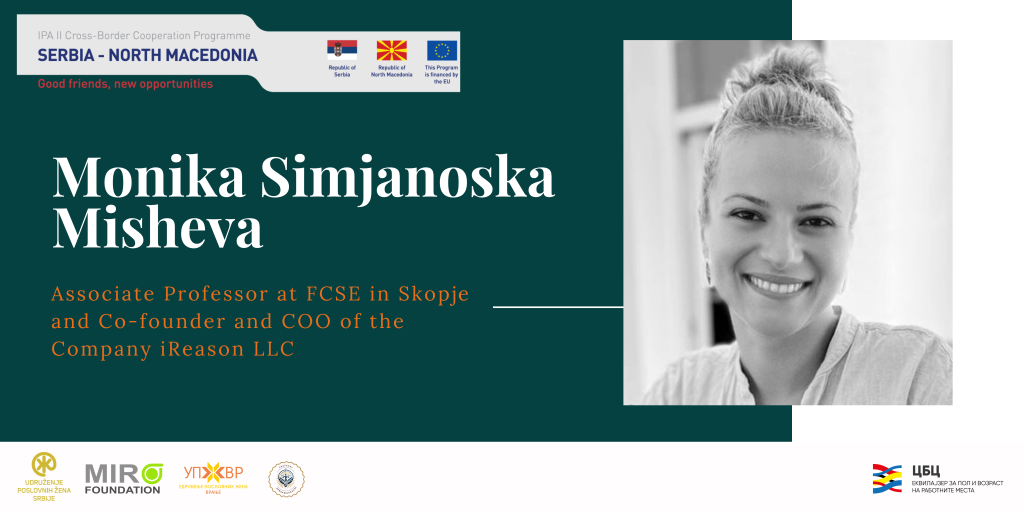
Monika Simjanoska Misheva – Associate Professor at the Faculty of Computer Science and Engineering in Skopje and Co-founder and COO of the Company iReason LLC
Within the framework of the project “CBC Job Gender and Age Equalizer” we have launched a series of interviews to promote good practices, laying emphasis on the contribution of women employed in traditionally male industries. Through their experiences and success stories we strive to encourage and motivate the programme target groups. In this interview, we are speaking with Monika Simjanoska Misheva, Associate Professor at the Faculty of Computer Science and Engineering in Skopje and Co-founder and COO of the Company iReason LLC.
Monika, could you please give us a brief introduction about yourself and your company?
I am Dr. Monika Simjanoska Misheva, an Associate Professor at the Faculty of Computer Science and Engineering (FINKI) in Skopje and the co-founder and COO of the company iReason LLC. My career takes place at the intersection of academia and industry, acquiring scientific research skills in the academic environment, whereas in the business context, I learn the mechanisms through which Artificial Intelligence (AI) can achieve successful commercialisation.
In academia, I am committed to research and development in the field of artificial intelligence, with a special focus on natural language processing, biomedicine, bioinformatics and embedded systems. Through my research, I try to understand the fundamental principles behind algorithms and their application in complex scientific problems. On the other hand, as a co-founder of iReason, I actively work on transforming this research into practical, market-oriented solutions. The solutions that stand out for their originality and applicability include the OpenBrain voice bot platform, which is already on the market and actively supporting AI-driven customer support in several large companies, as well as the HIPPO intelligent wearable device, which predicts hypertension from an ECG signal. In this role, I learned how technological innovations can be shaped to meet the needs of real users and achieve market sustainability.
I am currently introducing this perspective to academia as the coordinator of ChatMED, a new project funded by the EU’s Horizon programme. This initiative is aimed at connecting research institutions with the healthcare sector in the Widening Countries through the application of Generative AI (GenAI). The project not only opens new research opportunities, but also creates the basis for numerous partnerships with the industry, which means that ChatMED results can be transformed into tangible, commercially viable AI solutions.
What does success signify to you in your career, and how has this concept evolved from the beginning to where you are now?
Success is never an absolute category, it is subjective, fluid and deeply intertwined with the context in which we live. What once seemed like the pinnacle of achievement, over time becomes just another step on a longer journey. At different stages of life, success takes on new forms and meanings, shaped not only by our personal aspirations, but also by the expectations placed upon us by society.
In the early stages of academia, success was measured by acquiring knowledge and overcoming educational challenges. As time passed, the focus shifted towards professional growth, securing a suitable job, attaining higher titles and publishing a paper that could leave a lasting impact on the scientific community. Over time, what was once a personal milestone gradually transforms into a collective responsibility, so success becomes not merely an individual triumph, but something that brings value to the community.
At this stage, success for me is no longer solely defined by academic titles or recognition, but it is about the ability to create something that will have a real impact and serve as an illustration of value for future generations. However, despite all professional aspirations, one question remains ever-present: can success truly be considered genuine if, along the way, we have failed to cultivate a stable, happy environment for ourselves and those around us? In the end, perhaps the core definition of success is the ability to strike a balance between work and personal life, ambition and peace, creating and living.
What have been the greatest challenges you have encountered as a woman in this field and how did you overcome them?
One of the greatest challenges I encountered was the prolonged and uncertain wait for a faculty position. The process was exhausting, drawn-out and in many ways unfair, especially considering the biological nature of women. In the academic world, time is often of the essence – prolonged waiting not only leads to delays in one’s career, but also impacts personal life. Family, which should naturally complement professional development, is often sidelined, leading to consequences of its own. In instances when the journey felt too hard, the only option was to keep moving forward with work and research, demonstrating that a scientist’s worth should not be determined by bureaucratic processes. I decided to invest this time period in getting involved in projects, fostering collaborations and building a platform that would allow my professional growth despite administrative obstacles.
Today, I see this challenge as a lesson: academia is a slow-moving system, but persistence and dedication always yield results.
Do you have a moment or experience in your career that has been particularly inspiring or rewarding?
Throughout my lengthy career, there have been moments that remain etched in my memory, serving as affirmations that hard work and dedication truly pay off. I am now recalling three such moments that left a significant mark on me – each in its own way, at different stages of my professional journey.
The first was when I received the award for the best paper, at a time when I needed it the most, not only as academic recognition but also as tangible financial support, which provided me with security and motivation to keep moving forward. The second was the recognition as a successful female entrepreneur in December 2023, and the third, more recent and undoubtedly even more meaningful, was the moment when the project under my leadership, ChatMED, received the green light from the EU. This was not just a personal success, but also a confirmation that the idea held the potential to make a real impact – connecting researchers, healthcare professionals, and the industry towards improving the healthcare sector through artificial intelligence.
How do you think gender diversity affects the work environment and problem-solving in your workplace?
Although technical faculties are often perceived as predominantly male environments, the reality of my workplace is different – the gender representation among the staff is approximately 50-50, creating dynamics with its own unique balance, where diverse perspectives and approaches to work complement one another rather than compete against one another.
Women in the team often bring energy, freshness and willingness to change, infusing a dynamism that invigorates the daily academic flow. Additionally, they exhibit a strong empathy for students, which leads to a more inclusive and stimulating academic experience. On the other hand, male colleagues offer structure and rationality, and the combination of these two approaches leads to deeper and more effective problem-solving.
Interestingly, with this gender balance, the concept of family is naturally reflected in the work process. Problems are not viewed as individual battles, but as shared challenges that require teamwork and mutual understanding. This creates a more dynamic yet functional work environment, where different perspectives are not only respected, but actively leveraged to achieve better final outcomes.
In what ways do you think your work as a woman in this field will influence future generations?
Women are often tempted to take the seemingly easier path – one where the male gender assumes responsibility, solves problems and provides stability. Society frequently reinforces this role, offering comfort in exchange for ambition, security in exchange for independence. However, what may appear as a relief in the moment can mean unfulfilled potential, unrealised ideas and a feeling that something essential has remained unexpressed.
That is why it is important for women to forge their own path and find their own voice – not only for themselves, but also for those who will come after them. Future generations will not need to question their ability – they will know they can. They will see examples of women who did not wait for ideal circumstances, but created them themselves. If we fight today to be seen, tomorrow they will fight for new scientific breakthroughs, progress, a better society. If I can inspire even one woman to persist in traditionally difficult areas, then I know that the work I am doing holds lasting value.
What would you advise young women considering a career in this field?
To the young women considering a career in this field, I would say: focus on building your career when you are at your strongest, so that you can reap the rewards when you need them the most.
The concept of work-life balance is often promoted as crucial from the very beginning, but the reality is that balance is a privilege that comes over time. In the early years, when you have the energy, ambition and boundless capacity for work, that is when you need to commit to the fullest – to learn, explore, take risks and build a foundation that will set you on a stable path.
Later in life, when periods of vulnerability arise – whether due to family, health or other life circumstances – it is those early investments that will be your source of strength. The career you have built will provide you with flexibility, choices and security.
Therefore, I advise you not to fear imbalance in the beginning. On the contrary, embrace the period of all-in commitment as an investment in your future – because success does not emerge through balance, but through stages of intense work, followed by stages of reward and stability.
Did you have mentors or other forms of support that provided help throughout your professional journey? How do you perceive the significance of such support?
The most important lessons in life often come from unexpected sources and always catch us off guard. Sometimes it is a professor whose words sound like criticism, but later you realize those very words steered you in the right direction. Sometimes it is a colleague who unknowingly shows you how to manage stress. And sometimes, it is a completely random encounter that, without you being aware of it at that point, will open new doors for you.
The greatest wisdom is not just to ask for support, but to recognize it when it is offered to us. No one succeeds alone. We are all the result of those who believed in us, who pushed us forward and helped us – often without us even noticing.
Therefore, rather than waiting for perfect mentors, we should embrace every moment, every conversation and every challenge as an opportunity to learn. Sometimes, those who challenge us the most are the ones who shape us the most.